
In spite of the heavy rain, many alumni joined us for an alumni donor appreciation crawfish boil on the afternoon of
Study Analyzes How Environmental Disturbances Affect Whale Recovery
Tue, 08/21/2018 - 4:20pm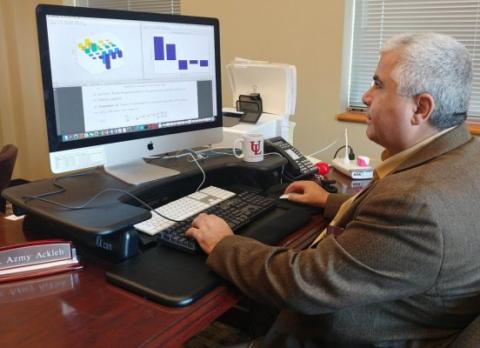
Top Stories
Students Sink Teeth into New Science Museum Exhibit
A new exhibit opening 1 May 2026 at the University of Louisiana at Lafayette Science Museum is putting student creat
Researchers (Azmy S. Ackleh (dean), Hal Caswell, Ross A. Chiquet (math), Tingting Tang (math), and Amy Veprauskas (math) modified a matrix population model to include the impact of a disturbance and study the recovery process for large marine mammal populations. They applied the model to identify key components in the recovery process for Gulf of Mexico sperm whales following a disturbance such as the Deepwater Horizon oil spill. Model simulations indicated that the magnitude of a disturbance’s impact had a greater effect on recovery time than did the duration of an event’s impact. Recovery time was also sensitive to the initial whale population’s structure and vital rates, with mature reproducing females contributing the most to shortening recovery time. Smaller populations, such as the sperm whale, were associated with larger variations in average recovery time due to their sensitivity to birth and death variations. This improved understanding of how whales recover from disturbances can help guide conservation and response efforts. The researchers published their findings in Natural Resource Modeling: Sensitivity analysis of the recovery time for a population under the impact of an environmental disturbance.
Read more in this August 14, 2018 feature article on the Gulf of Mexico Research Initiative webpage.
Photo: Dean Ackleh works with a modified population matrix model to see how an environmental disturbance can affect large marine mammal recovery. (Phot provided by Azmy Ackleh.)