
Dr. Sercan Aygün Builds Research Momentum with New NSF Awards
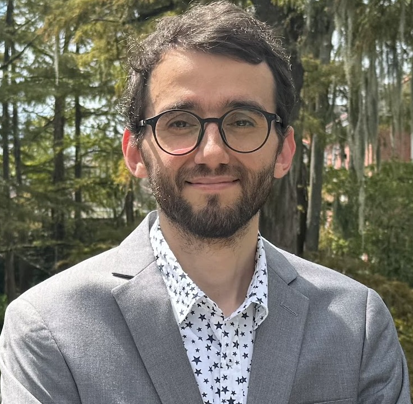
The Ray P. Authement College of Sciences is proud to celebrate the outstanding accomplishments and growing national recognition of Dr. Sercan Aygün, Assistant Professor in our School of Computing and Informatics.
Since joining UL Lafayette in 2024, Dr. Aygün has established a rapidly growing research program focused on the future of artificial intelligence, emerging computing technologies, and energy-efficient machine learning systems. His recent success in securing two awards from the National Science Foundation reflects both the importance of his research and the growing strength of artificial intelligence and computing research in the College of Sciences.
Dr. Aygün's research explores how innovative and unconventional computing methods can make artificial intelligence systems faster, more energy-efficient, and better suited for real-world applications. He leads the tiny Machine Learning and Embedded Computing (tML-EC) Laboratory, where researchers investigate emerging approaches in hyperdimensional computing, stochastic computing, embedded systems, and TinyML.
Advancing AI Through Innovative Computing
As artificial intelligence becomes increasingly integrated into healthcare, scientific discovery, environmental monitoring, autonomous systems, and countless other areas, researchers face significant challenges in developing AI systems that can process large amounts of information while operating efficiently and reliably. Dr. Aygün's work addresses these challenges by exploring new computing architectures and algorithms designed to improve the efficiency, adaptability, and accessibility of artificial intelligence. His research is particularly focused on developing approaches that can enable powerful AI capabilities on devices and systems with limited computing power and energy resources.
This work has the potential to expand the use of artificial intelligence beyond large data centers and powerful computing systems, making advanced AI technologies more practical for embedded devices, edge computing, and other applications where energy efficiency and computational resources are critical considerations.
NSF Support for Biomedical Big Data Research
Among Dr. Aygün's recent accomplishments is his reception of the NSF EPSCoR Research Fellows “Quantum-Inspired Vector Symbolic Architectures for Biomedical Big Data Processing” award to support his research.
The project explores innovative computing architectures designed to address the growing challenges associated with processing and analyzing large and complex biomedical datasets. As advances in modern science and medicine generate increasingly vast quantities of information, new computational approaches are needed to efficiently analyze data and identify meaningful patterns. By drawing inspiration from quantum computing and vector symbolic architectures, Dr. Aygün's research seeks to develop more efficient methods for processing biomedical big data. The work brings together emerging computing concepts and artificial intelligence to explore new ways of representing, analyzing, and extracting information from complex datasets.
This research will help advance the development of computing technologies capable of handling the increasing scale and complexity of data generated in biomedical research while reducing the computational and energy demands associated with traditional approaches.
Expanding Research in Artificial Intelligence
Dr. Aygün has also received a second recent NSF award “Memory-centric Architectures for Distributed Edge Intelligence” further strengthening his growing portfolio of externally funded research and highlighting his work at the forefront of artificial intelligence and emerging computing technologies.
This support advances research aimed at developing new approaches to AI that are more efficient, adaptable, and capable of operating in environments where traditional computing systems may be limited by power, speed, or hardware constraints. As artificial intelligence continues to transform fields ranging from healthcare and scientific discovery to environmental monitoring and autonomous systems, Dr. Aygün's research focuses on addressing some of the fundamental computational challenges associated with deploying advanced AI in real-world applications.
His work explores innovative computing architectures and algorithms that could help make AI systems faster, more energy-efficient, and accessible across a wider range of devices and technologies. By investigating alternatives to conventional computing approaches, Dr. Aygün and his research team are working to develop technologies that can bring advanced artificial intelligence closer to the devices and environments where it is needed.
This award represents another important step in the growth of Dr. Aygün's research program and reinforces the College of Sciences' expanding role in advancing innovative research in artificial intelligence.
A Growing Record of Research Excellence
These recent NSF awards build upon an already impressive record of achievement for Dr. Aygün. His work has received national and international recognition, including his selection as an MLCommons Rising Star in Machine Learning and Systems Research. He has also earned Best Paper and Best Poster honors at major conferences and continues to establish a growing record of scholarship and innovation in the rapidly evolving fields of artificial intelligence and computing systems.
Dr. Aygün's continued success reflects the strength of research and innovation within the School of Computing and Informatics and the Ray P. Authement College of Sciences. His work exemplifies how our faculty are advancing fundamental research while developing innovative technologies with the potential to address important challenges in healthcare, scientific discovery, artificial intelligence, and other emerging fields.
As Dr. Aygün continues to expand his research program and mentor the next generation of computing researchers, his recent NSF awards represent another significant step forward for artificial intelligence and emerging computing research in the Ray P. Authement College of Sciences.
For more information about Dr. Aygün's research and the tiny Machine Learning and Embedded Computing (tML-EC) Laboratory, please follow this link to his research page.